Is Kraken Available in New York? Licensed NY Crypto Exchanges
No, Kraken is not available in New York. Kraken's own page on where it is licensed, last updated on 30 September 2026, says it does not offer services to residents of New York or Maine. Neither Kraken nor its parent company, Payward, appears on the list of regulated virtual currency entities kept by the New York State Department of Financial Services (NYDFS), which we read on 12 October 2026. A New Yorker who wants to buy crypto has to use a firm that holds a BitLicense or a New York limited purpose trust charter. On that list the consumer names include Coinbase, Gemini, Robinhood Crypto, PayPal, Cash App's parent Block, eToro and Bitstamp USA.
This dispatch turns the NYDFS register into a dated table of the crypto exchanges and apps available in New York. It also covers the BitLicense versus the trust charter, which coins New York apps can list, bitcoin ATMs, and how to buy bitcoin in New York. It is general information checked on 12 October 2026, not financial or legal advice; licences change every year, so confirm a firm's status before you send money.
Who this suits: New York residents choosing a first app, and newcomers whose old exchange has closed to them. It is no use to anyone hunting for a workaround: an out-of-state address or a VPN breaks the platform's terms and leaves you outside New York supervision.
Is Kraken available in New York? The answer, with sources
Two independent sources agree. Kraken's support article on geographic restrictions states that "at this time, Kraken (including Kraken Securities LLC and Kraken Adviser LLC) does not offer services to residents of" Maine and New York. And when we searched the NYDFS table of regulated entities, which had 39 rows on 12 October 2026, neither "Kraken" nor "Payward" appeared. Kraken serves residents of the other US states, so a friend in New Jersey or Connecticut may use it without problems; what matters is the state you live in, not the state you work in.
The exclusion covers Kraken's add-on products too. Its bitcoin staking service, which runs through the Babylon protocol, is described by Kraken as available in the United States "excluding Maine and New York". Some pages that rank for this question suggest Kraken has a New York presence; on the evidence above, a New York resident cannot open or keep a Kraken account, so this page does not link to it.
What the BitLicense is, and how the trust charter differs
New York's virtual currency regulation, 23 NYCRR Part 200, was issued by NYDFS in June 2015 and is the origin of the BitLicense. NYDFS says a BitLicense is needed by anyone who engages in Virtual Currency Business Activity involving New York or New Yorkers. That covers five things: transmitting virtual currency, holding it in custody for others, buying and selling it as a customer business, performing exchange services as a customer business, and controlling, administering or issuing a virtual currency. A consumer who buys bitcoin only as an investment does not need a licence. The firm selling it to you does.
There is a second route into the state. Instead of a BitLicense, a firm can be chartered under the New York Banking Law, usually as a limited purpose trust company, with approval to conduct virtual currency business. NYDFS notes that a trust company can exercise fiduciary powers, which a BitLicensee cannot, and that it can carry out money transmission in New York without a separate money transmitter licence. Gemini is the best-known consumer example: Gemini Trust Company has held a limited purpose trust charter since October 2015, and its own New York page names NYDFS as its licensing authority. PayPal uses both models, with PayPal, Inc. holding virtual currency and money transmitter licences and PayPal Digital, Inc. holding a trust charter granted in May 2024.
Crypto exchanges and apps available in New York (dated table)
These are the consumer-facing firms from the NYDFS table, with the authorisation type and the grant month NYDFS shows. Custody and institutional firms such as Anchorage Digital, BitGo, Fireblocks and NYDIG are left out. Inclusion means NYDFS authorisation, not a verdict on fees or service.
| Brand | Entity on the NYDFS list | Authorisation | Granted |
|---|---|---|---|
| Gemini | Gemini Trust Company, LLC | Limited purpose trust charter | Oct 2015 |
| Coinbase | Coinbase, Inc. | Virtual currency + money transmitter licences | Jan 2017 |
| bitFlyer | bitFlyer USA, Inc. | Virtual currency licence | Nov 2017 |
| Cash App | Block, Inc. (formerly Square) | Virtual currency + money transmitter licences | Jun 2018 |
| Robinhood | Robinhood Crypto, LLC | Virtual currency + money transmitter licences | Jan 2019 |
| Bitstamp | Bitstamp USA, Inc. | Virtual currency licence | Apr 2019 |
| PayPal | PayPal, Inc. | Virtual currency + money transmitter licences | VC Oct 2020 (table shows Jun 2022) |
| Coin Cafe | Coin Cafe, Inc. | Virtual currency licence | Jan 2023 |
| eToro | eToro NY LLC | Virtual currency + money transmitter licences | Feb 2023 |
| PayPal | PayPal Digital, Inc. | Limited purpose trust charter | May 2024 |
| MoonPay | MoonPay USA LLC | Virtual currency + money transmitter licences | Jun 2025 |
| Bullish | Bullish US Operations LLC | Virtual currency + money transmitter licences | Sep 2025 |
| Zap Solutions | Zap Solutions, Inc. | Virtual currency + money transmitter licences | Feb 2026 |
| GalaxyOne | GalaxyOne Prime NY LLC | Virtual currency + money transmitter licences | May 2026 |
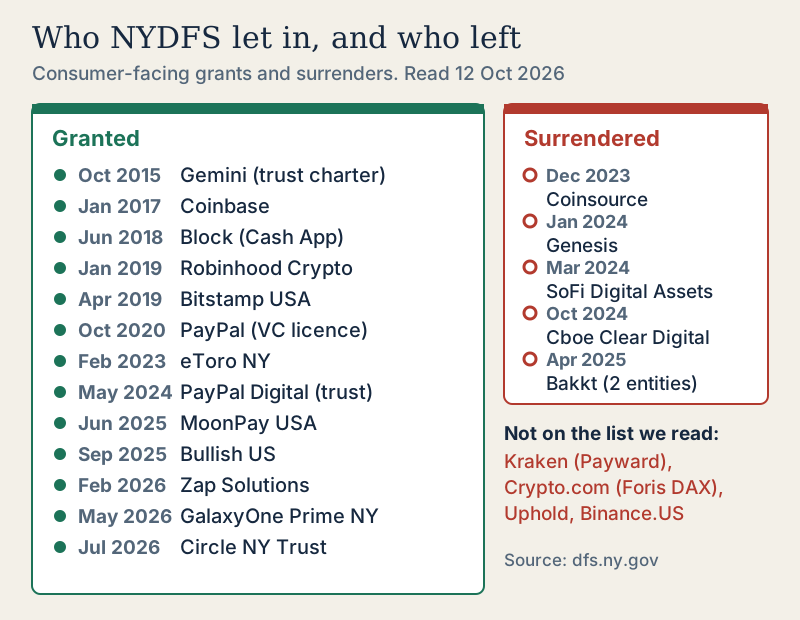
Read the list in both directions. Since mid-2025 NYDFS has added MoonPay USA, Bullish US, Zap Solutions, GalaxyOne Prime NY and Mastercard Transaction Services, and in July 2026 it chartered Circle's New York trust company. In the other direction, five firms have handed back their New York authorisation since the end of 2023: Coinsource on 27 December 2023, Genesis on 3 January 2024, SoFi Digital Assets on 25 March 2024, Cboe Clear Digital on 11 October 2024 and two Bakkt entities on 10 April 2025. A guide written before those dates can name an app that no longer serves the state.
Several well-known names were missing when we read the table: Kraken (Payward), Crypto.com (Foris DAX), Uphold and Binance.US. Absence is strong evidence but not proof, since a firm could serve New Yorkers through a licensed partner, so check the provider's own state list too. Binance.US, for one, lists New York among the states where you cannot register.
If you want a large, established platform with a New York authorisation, Coinbase holds both a virtual currency and a money transmitter licence, and Gemini operates under its trust charter. You can open a Coinbase account or open a Gemini account; both are affiliate links, and both firms appear on the NYDFS list we read. Bitstamp USA is licensed too and is mentioned on merit; it pays us nothing.
Coins you can and can't buy in New York
A New York licence does not let a firm list any token it likes. NYDFS describes three routes. A firm can apply for approval of a specific coin as a material change to its business. It can operate under a coin-listing policy that NYDFS has approved, which lets it self-certify eligible coins under guidance issued in November 2023. Or it can list coins from the NYDFS Greenlist without a separate policy, provided it tells NYDFS at least ten days before offering the coin in New York.
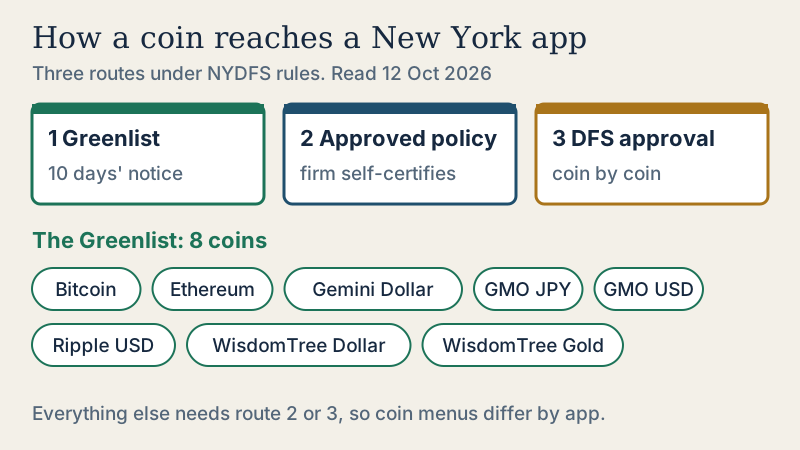
The Greenlist we read on 12 October 2026 held eight coins: Bitcoin and Ethereum, plus six stablecoins approved for issuance in New York, namely Gemini Dollar, GMO JPY, GMO USD, Ripple USD, WisdomTree Dollar and WisdomTree Gold. Everything else on a New York app's menu got there through an approved policy or a specific approval, which is why two licensed apps can show New Yorkers different coin lists and why the same app can show you fewer coins than it shows a friend in another state. NYDFS also reserves the right to halt, delist or limit any coin at any time.
Products beyond plain buying vary as well. Cash App says its Lightning Network payments are not available to New York residents. eToro's US staking page lists New York among the states where staking is not offered. Robinhood says crypto transfers in and out of its app are available in every US state, which matters if you plan to move coins to your own wallet. Check the specific feature, not just the app, before you choose.
Bitcoin ATMs in New York
Bitcoin kiosks fall under the same rules. A kiosk that takes your cash and hands you bitcoin is buying and selling virtual currency as a customer business, one of the five activities NYDFS lists, so its operator needs New York authorisation. The operator's name should be on the kiosk; look it up on the NYDFS list before you use it. The table includes Moon Inc., which trades as LibertyX, and Cottonwood Vending, both licensed in January 2019, while Coinsource surrendered its New York licence in December 2023. A licensed kiosk is still a costly way to buy: Bitcoin Depot, which runs about 9,700 machines, describes a “higher markup” on kiosk sales in its 2025 annual report but publishes no single figure.
Kiosks are also where a large share of crypto fraud lands. The FBI's Internet Crime Complaint Center received 13,460 complaints involving cryptocurrency ATMs in 2025, with reported losses of $389 million, and people aged 60 or over filed 6,188 of those complaints and lost $257.5 million. These are national figures. The pattern is the same everywhere: a caller posing as a bank, a utility or a government agency tells you to withdraw cash and feed it into a kiosk. The Federal Trade Commission puts it plainly: only scammers demand payment in cryptocurrency.
How to buy bitcoin in New York, step by step
The sequence below works with any licensed app. It confirms the firm can serve you before you hand over documents, funds the account the cheapest way, and settles where the coins will live. Each step is something you can check yourself rather than relying on our reading of a register that changes during the year.
- Find the firm on the NYDFS regulated entities list and note the exact legal entity, such as Coinbase, Inc. or Gemini Trust Company, LLC.
- Start sign-up and select New York as your state of residence. A firm that excludes the state should stop you here; do not give another address.
- Complete identity checks with photo ID and proof of address.
- Fund the account by bank transfer where possible, and read the fee screen before you confirm a card purchase.
- Place a small first order, then check what you actually received against the amount you paid.
- Decide whether to keep the coins on the platform or withdraw them to a wallet you control, and keep records for tax.
Costs differ by app, and the cheapest-looking button is not always cheapest. Figures read from each provider's US pages in October 2026: Gemini's ActiveTrader screen starts at 0.60% for maker orders and 1.20% for takers on its entry tier. Robinhood charges no commission on its default routing and earns about $0.95 per $100 traded through the spread. Cash App charges 2.0% on bitcoin buys from $1 to $499, falling to 0% above $2,000, plus a spread of up to 0.75%. PayPal charges 2.20% on purchases under $75, falling to 1.50% above $1,000, and adds an estimated 1.00% spread. eToro US charges 1% to buy or sell. We could not read Coinbase's fee pages, so we give no Coinbase figure; check its order preview. Our guide to local payment methods explains why a bank transfer usually beats a card.
What a New York licence does and does not protect
A BitLicense or trust charter means NYDFS reviewed the firm's controls and people before authorising it, and supervises it afterwards; its licensing page points licensees to New York's cybersecurity and transaction-monitoring rules. It does not make your coins a bank deposit. Coinbase, for example, says in its 2025 annual report that no government agency insures or guarantees the crypto it holds for customers, and that although its user agreements treat custodied assets as customer property under UCC Article 8, courts have not yet tested that position for crypto in a bankruptcy. NYDFS itself issued updated guidance on custodial structures for customer protection in the event of insolvency on 30 September 2025, a sign that the question is live rather than settled.
Crypto can lose value quickly, and you could lose your whole stake. A New York licence is supervision, not insurance, and a balance on an exchange is not an FDIC-insured deposit. This is general information dated 12 October 2026; it is not advice on investments, law or tax.
Tax is a separate question from licensing, and buying through a licensed app does not change what you owe; our dispatch on whether your country taxes crypto gives the concepts and the official starting points. For the federal and multi-state picture behind this page, see our US crypto exchange landscape.
Edge cases
If you move to New York with a Kraken account, read Kraken's terms on changing residence before you update your address; it may ask you to withdraw. If you live in New Jersey and work in Manhattan, an exchange checks your state of residence. A short coin menu on a New York app is not a fault; it reflects the Greenlist and the app's approved listing policy. If someone offers to buy crypto for you through an unlicensed platform, or tells you to use a VPN to reach a foreign exchange, walk away. And if you are comparing states or countries, our best crypto exchange by country map puts New York's rules beside the rest of the US and abroad.
New York crypto questions at the border
Is Kraken available in New York?
What crypto exchanges are available in New York?
Is Crypto.com available in New York?
Which coins can I buy in New York?
Can I use Cash App to buy bitcoin in New York?
Zoom back out: see the best crypto exchange by country, or the deeper dive on the best crypto exchange in the UK. Country rules change — every claim here is dated, and none of it is financial or legal advice.